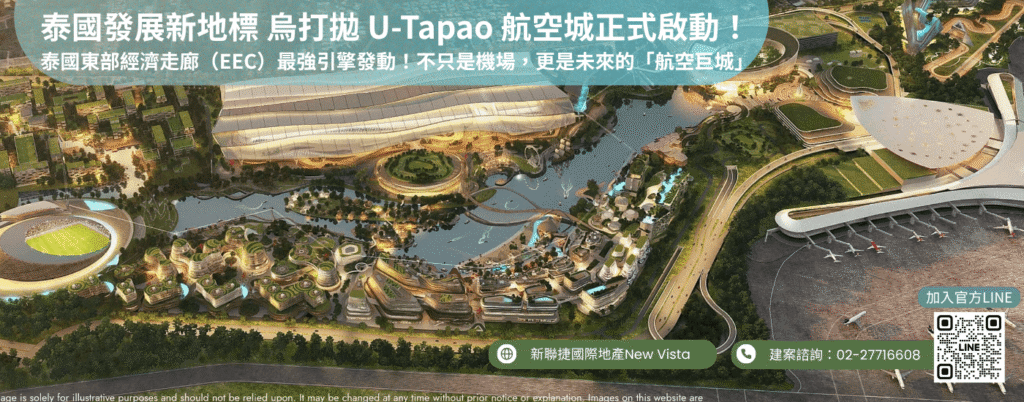
Construction on “Uta Fort International Airport” will officially begin on April 3, 2026, marking the start of a 50-year concession.
Dr. Chula Sukmanop, Secretary-General of the Eastern Economic Corridor (EEC) Committee, stated that the total investment for the “Uttaburi International Airport and Eastern Aviation City Development Project” is approximately 290 billion baht.
The EEC will officially issue a Notice to Proceed (NTP) to U-Tapao International Aviation Co., Ltd. (UTA) on April 3, 2026. That date will also be considered the official start date of the project and will mark the beginning of the 50-year concession period, which is expected to expire in the year 2076.
This project is one of the EEC’s core flagship infrastructure initiatives. In the future, it will integrate airport operations, the development of the aviation industry, and the construction of a smart aviation city, thereby further enhancing Thailand’s air transport capacity and regional competitive advantage.
On January 29, 2026, EEC formally signed a contract management agreement with UTA for this project, The agreement stipulates that UTA waives the “Conditions Precedent” in the joint investment contract regarding the construction and operation of the “Three-Airport High-Speed Rail Link Project.” Since delays in this high-speed rail project have a significant and substantial impact on the Fort Uta Airport and Eastern Aviation City development project, this adjustment to the terms is therefore regarded as a crucial step in moving the project forward.
According to the original investment plan, the “Wutabou International Airport Development Project” will be implemented in six phases. In Phase 1, the airport facilities must have the capacity to handle no fewer than 12 million passengers per year. Subsequent expansion investments for Phases 2 through 6 will be initiated once actual passenger volume in each phase reaches 80% of that phase’s design capacity (80%), ensuring that infrastructure expansion keeps pace with market demand and enhancing investment efficiency and operational flexibility. The overall planning objective is to increase the airport’s annual passenger handling capacity to 60 million by the project’s final year, thereby developing U-Tapao Airport into a regional international aviation hub and strengthening the overall capacity of Thailand’s air transport system.
According to the current development plan, the construction of Wuta堡 Airport will take five years, with the goal of officially opening in 2031.
Construction on Uta Fort International Airport is currently proceeding according to plan. The total project duration is 1,095 days, including a 30-month construction period and a 6-month system testing period. Completion is scheduled for October 29, 2028, ensuring a seamless transition to the official opening of the airport’s first phase. Regarding Phase 1 development, UTA’s investment includes:
- Passenger Terminal (Airport Terminal)The new terminal covers an area of more than 157,000 square meters and has an annual passenger handling capacity of over 12 million.
- Air Cargo & Logistics CenterThe facility is designed to handle more than 1 million metric tons of cargo annually to support regional logistics and international trade needs.
- Airport City ProjectIt features a diverse range of commercial and entertainment facilities, including a world-class shopping mall, a convention and exhibition center (MICE), a large indoor arena, hotels, a racetrack, dining options, a medical tourism hub, and a Formula One racetrack.
In addition, while certain sections of the Three-Airport High-Speed Rail Link project are planned as underground tunnels running beneath the runways, and although construction on this high-speed rail project has not yet officially begun, it will not affect the construction schedule for the second runway and passenger terminal at Wutao Airport. Through coordination, the necessary engineering design adjustments have been completed to ensure that these two major infrastructure projects can be carried out in tandem and proceed smoothly.
Source: Bureau of Foreign Trade, Ministry of Economic Affairs