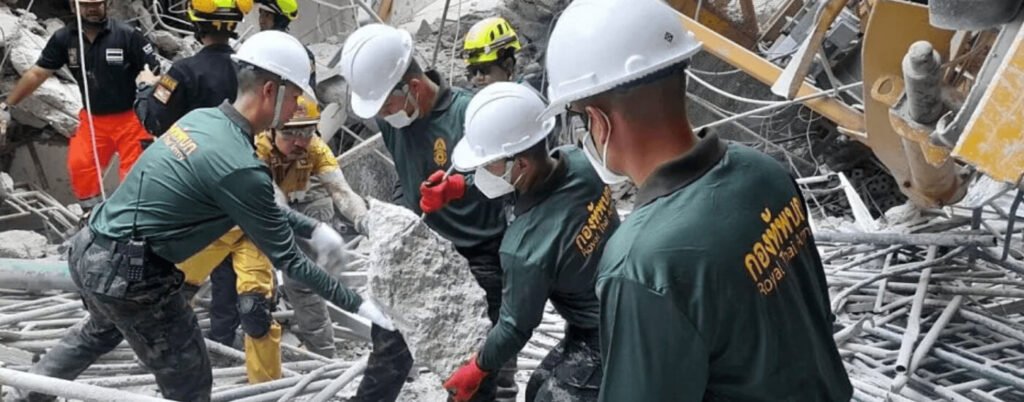
Recently, the 7.7-magnitude earthquake that struck Myanmar on March 28, 2025, had a significant impact on Thailand, particularly Bangkok. In Bangkok, a 30-story office building under construction collapsed, killing at least 12 people and leaving dozens missing. This incident has sparked widespread concern regarding Thailand’s building codes and seismic design standards.
According to reports, the collapsed building had quality issues during construction, and Thailand’s anti-corruption watchdog had previously issued warnings regarding the building’s construction quality. In addition, preliminary inspections by Thailand’s Ministry of Industry found that substandard steel had been used in the building.
The Thai government has ordered safety inspections of approximately 11,000 high-rise buildings to ensure they comply with seismic design standards. These standards include the setting of parameters such as the seismic zoning coefficient (Z-value), structural coefficient (K-value), site-structure resonance coefficient (S-value), and importance factor (I-value).
In addition, Thailand enacted new seismic codes (B.E. 2564) in 2021, raising the requirements for design seismic forces. These new codes are intended to enhance the seismic resistance of buildings and ensure that they remain structurally safe even under higher seismic forces.
In short, the recent earthquakes have exposed problems in Thailand regarding construction quality and oversight, prompting the government and relevant agencies to reevaluate and strengthen the enforcement of building codes and seismic design standards.
Thailand’s primary building code is the Building Control Act (B.E. 2522), which was enacted in 1979 and amended in 1992, 2000, and 2007. This Act aims to regulate the design, construction, alteration, and demolition of buildings to ensure public safety, health, and welfare.
The main content includes:
- Building Permit System:Permission from the local competent authority must be obtained before proceeding with any construction, renovation, or demolition.
- Building Standards and Codes:It specifies technical standards such as building types, dimensions, structural strength, and material specifications.
- Safety and Durability Requirements:It is emphasized that buildings must meet safety, durability, and material specification requirements to ensure structural stability and the safety of occupants.
- Environmental Impact Assessment (EIA):For certain types or sizes of construction projects, an environmental impact assessment may be required to ensure that the environmental impact remains within acceptable limits.
- Enforcement and Penalties:The regulations stipulate corresponding penalties for violations, including fines and imprisonment.
In addition, Thailand has the Energy Conservation Promotion Act, which complements the Building Control Act and aims to promote energy efficiency and sustainable building practices.
Recently, the Thai government has also been continuously updating and refining relevant regulations to address new construction technologies and safety standards.
Overall, Thailand’s building code system is designed to ensure that construction activities are safe, sustainable, and environmentally friendly.